
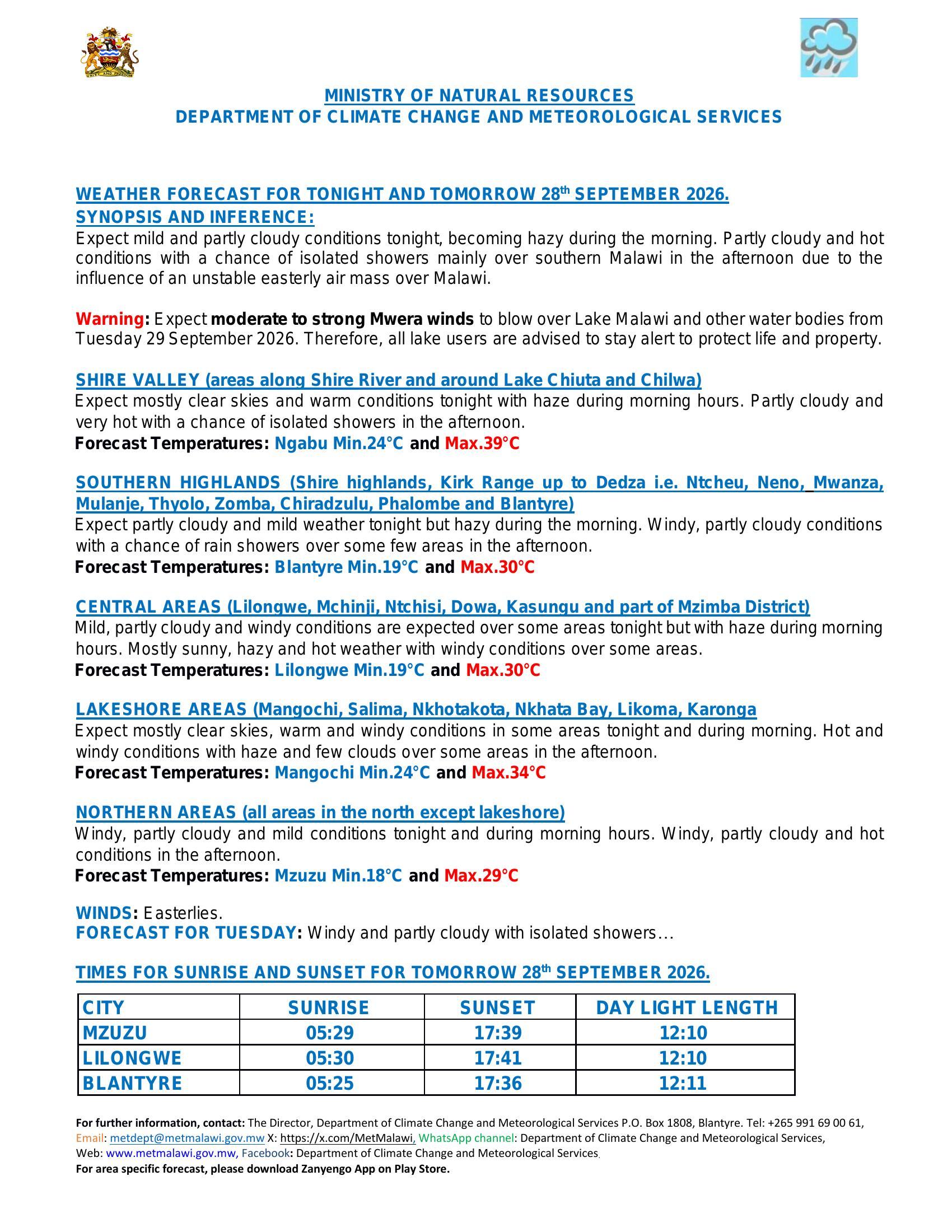
Malawi's Department of Climate Change and Meteorological Services forecast a continuation of hot and hazy conditions across most areas for late September. According to the department's September 27 update, the weather is driven by an unstable easterly air mass, which is also expected to bring isolated afternoon showers primarily to southern Malawi. The department advised that air quality might range from moderate to unhealthy for sensitive groups in the south.
In conservation news, environmental advocates marked World Environmental Health Day on September 26 with calls for stronger climate resilience. The Ministry of Health and the Malawi Environmental Health Association urged citizens to adopt climate adaptation methods, such as responsible waste management, protecting water sources, and planting more trees. The associations stressed that community-level environmental health is critical for disaster risk reduction and adapting to future weather shocks.
Meanwhile, a report published by Mongabay on September 25 highlighted regional efforts to save disappearing wild fruit trees. Scientists at gene banks in Malawi, Zambia, and Zimbabwe are using cloning techniques to preserve species like the wild loquat, which provide essential income and food for local communities. The conservation push comes as severe deforestation threatens the region. According to researchers, Malawi lost nearly 17,700 square kilometers of its dry forest biome between 2000 and 2023 due to charcoal production and agricultural expansion.