
Malawi has strengthened its public health response capabilities through the Strengthening Outbreak Notification and Response (SONAR) initiative. Backed by the Global Fund and The Task Force for Global Health, the programme has equipped local health workers with digital tablets for real-time reporting to accelerate the detect, report, and response cycle. These early warning systems recently proved successful in swiftly containing contagious measles outbreaks in Mangochi and Machinga, minimising casualties and preventing cross-border transmission into Mozambique, according to updates from the Global Fund.
Despite this progress, a newly published April 2 study in PLOS One highlights ongoing problems in treating patients with multiple conditions at Malawian public hospitals. Research conducted at Queen Elizabeth Central Hospital in Blantyre and Chiradzulu District Hospital reveals that care remains highly fragmented. The study notes that reliance on single-disease donor funding and frequent stockouts of essential diagnostic supplies often delay patient diagnosis and management.
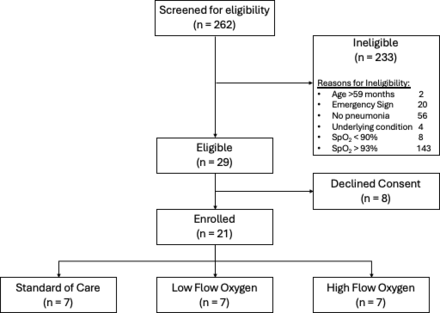
On a clinical note, a pilot randomised controlled trial for paediatric oxygen therapy, dubbed NoGoLO2, was successfully executed in a local Malawian hospital. Published in BMJ Paediatrics Open, the study evaluated standard care against low-flow and high-flow nasal cannula oxygen for children suffering from pneumonia. Supported by the UNC Project Malawi, researchers demonstrated the ability to use modern medical treatments in under-resourced settings. However, they noted that community misconceptions and fears surrounding oxygen therapy remain a barrier to treatment acceptance.
In other health news, the Malawi Bureau of Standards laboratory has improved its food safety testing using nuclear science, according to the International Atomic Energy Agency. With international support, the laboratory can now detect toxic metals, veterinary drug residues, and radionuclides in local products such as milk, tea, and macadamia nuts. This upgraded testing capacity aims to protect domestic consumers from health risks while ensuring Malawian agricultural exports meet strict international standards.